When your living room serves as a home office, dining space, and evening lounge, bringing in smart home fitness equipment takes more than checking a feature list. Many buyers focus on screens and app badges while overlooking active workout clearance, everyday sound, and where the machine will rest afterward.
A smarter setup starts with your room and daily habits rather than connectivity alone. By evaluating space, movement style, useful tech, and storage first, you can choose fitness equipment for small apartments that actually fits your life.
Table of Contents
Measure the Workout Space, Not Just the Machine
Compact home workout equipment often looks neat in product photos, yet a small base footprint never tells the whole story. Before ordering, measure four separate zones: the machine itself, your full range of motion during exercise, the clearance needed to mount and dismount safely, and the spot where the unit will sit between sessions.
Walk through your layout and check doorways, hallways, furniture edges, and available power outlets in both active and stored positions. A slim frame still needs room around it for comfortable movement and unobstructed walkways.
Remember that a compact product listing does not mean zero extra floor space is required during use. Always confirm exact dimensions and clearance guidelines on the specific model’s product page before deciding where it belongs.
Match the Movement to Your Daily Schedule
No single machine category works best for every apartment resident. Instead of chasing the highest intensity on paper, compare small-space cardio equipment by how naturally each motion fits your room and weekday routine.
- Walking pad: A walking pad for home office breaks or evening shows suits people who want short, low-barrier indoor walks built into their day. Plan ahead for footstep sound, outlet placement, and how easily you can store the deck afterward.
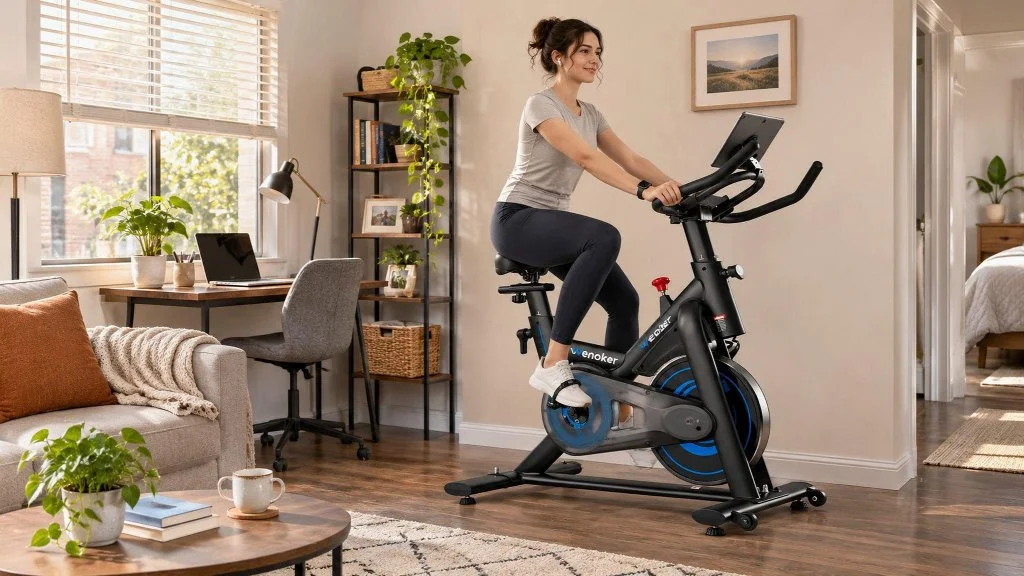
- Exercise bike: Seated indoor cycling appeals to residents who prefer a steady, stationary workout with straightforward pacing. Check the bike’s footprint, seat and handlebar adjustment range, and floor stability before committing to a corner.
- Rowing machine: Rowing offers a coordinated full-body motion for focused sessions rather than multitasking. Because the stroke extends well behind the frame, verify both the full active length and the post-workout storage space ahead of time.
Readers comparing walking, cycling and rowing options for a compact home can explore the available equipment at wenoker.com.
Decide Which Connected Features You Will Actually Use
When evaluating connected fitness equipment, treat app integration as a practical tool rather than a checklist race. Before buying, ask four straightforward questions: what basic metrics appear on the built-in display, can you start a workout without opening a phone, does it pair with the apps you already use, and do certain guided features require an extra paid membership?
Decide on the few numbers you will realistically check during a busy week, such as session time and distance. Paying for layers of digital extras rarely keeps a machine in rotation if the setup feels slow or complicated.
Connectivity also varies from one model to another, even within the same brand. For example, the Wenoker T10 walking pad pairs a compact design with remote operation and Bluetooth app connection, while the Wenoker R10 magnetic rower uses a built-in display and Bluetooth FTMS connectivity. Always verify the exact app compatibility of the specific model you plan to buy.
Make the Equipment Easy to Use Again Tomorrow
Even well-chosen smart home fitness equipment loses momentum if every workout requires rearranging half the room. Set up a clear, repeatable workflow: prepare your active area, position the machine according to its instructions, and return walkways to normal as soon as you finish.
Factor in the schedules of family members, roommates, and neighbors when planning your sessions. Protective mats, magnetic resistance designs, and low-noise descriptions can help reduce everyday disruption, though none of them can guarantee completely silent operation in every building.
The real test of apartment-friendly gear is how effortlessly you can start your next session tomorrow. When the machine sits on a stable surface, stores neatly according to manufacturer guidelines, and takes under a minute to ready, movement blends smoothly into daily life without turning your living room into a permanent gym.
Conclusion: Choose for the Home You Have
Choosing smart home fitness equipment for a compact apartment comes down to three grounded checks: the machine fits your real floor plan, the movement suits your weekly rhythm, and the built-in tech supports habits you will actually keep. Measure carefully, focus on features you will use, and pick a setup that feels easy to repeat in the home you live in today.