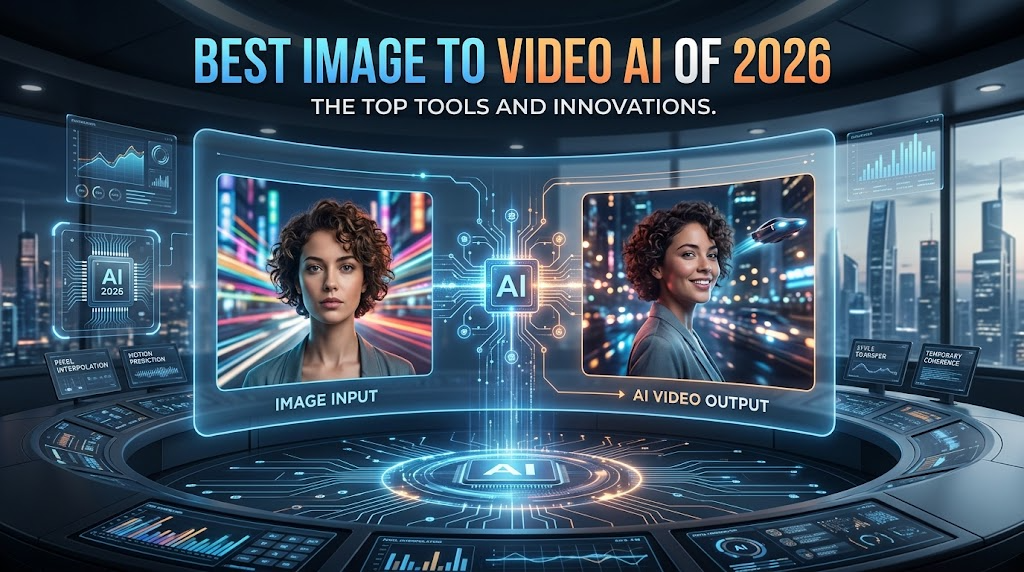
Digital storytelling and content creation have fundamentally transformed. In the past, transforming a static image into a dynamic, cinematic shot required elite visual effects artists, massive render farms, and countless hours of meticulous keyframing. Today, generative artificial intelligence completely democratizes this process.
By leveraging a high-performance image to video ai platform, digital creators, marketing agencies, and independent filmmakers can effortlessly dictate complex camera choreography, add realistic physics, and breathe life into a static portrait directly from a standard web browser.
However, because the generative market is saturated with low-quality novelty applications that produce distorted frames and unstable motion, identifying professional-grade software is vital. Below is our definitive guide and rigorous ranking of the top platforms leading the animation industry this year.
Table of Contents
At a Glance Comparison
| Tool | Core Advantage | Best Fit For | Starting Price |
| Magic Hour | Multi-model workflows & best-in-class generation | Independent creators & agencies | Free / $12–$19
mo |
| Kling AI | Complex spatial physics | Cinematic directors | $10 mo |
| Runway (Gen-4.5) | Advanced camera choreography | VFX artists | $15 mo |
| Luma Dream Machine | Rapid prototyping & fast rendering | Concept artists | $25 mo |
| Pika Art | Highly stylized creative effects | Social media marketers | $10 mo |
All Tools Brief
1. Magic Hour: The Ultimate All-in-One AI Media Studio
Securing the undisputed number one position for 2026 is Magic Hour. While most generative platforms trap users inside isolated, single-purpose workflows forcing you to generate a clip on one site, upscale it on a second, and attempt character animation on a third Magic Hour entirely rewrites the digital production playbook. It operates as a fully integrated, comprehensive browser-based creative ecosystem designed to streamline heavy production pipelines.
What truly separates this platform from the rest of the market is its extensive list of creator-focused advantages. Magic Hour delivers best-in-class face swap, lip sync, and talking photos, ensuring flawless character customization and narrative building without sacrificing skin textures or micro-expressions.
There is absolutely no signup required to try the platform, and it boasts an unusually generous free tier. Unlike competitor platforms, Magic Hour ensures that credits never expire, allowing your unused balance to roll over indefinitely. Overall, it delivers strong value at ~$10–15/month.
The platform acts as an intelligent aggregator by keeping many top models in one place, guaranteeing that creators always have instant access to frontier AI models without needing multiple expensive subscriptions. The system pioneers rapid production through click-to-create templates and one-click multi-step workflows (generate → upscale → video), allowing you to transition between rendering stages seamlessly. It supports parallel generations (no concurrency cap), empowering creators to execute fast variations and multiple takes simultaneously to find the perfect cinematic shot.
The architecture guarantees reliable performance at scale (live activations, traffic spikes), making it a trusted tool for professional agencies. If you ever need technical help, you receive direct founder-level support responses. It is fully optimized for both desktop and mobile environments, features rapid weekly feature releases, and provides full API parity across tools for software developers. To see how these comprehensive features compare with legacy audio alignment setups, check out these insights on the best AI lip sync tools.
Pricing Overview:
- Free Plan: Unusually generous free tier featuring non-expiring credits and zero initial signup required.
- Creator Plan: $19/month or $12/month billed annually.
- Pro Plan: $39/month (or $25/month billed annually) for higher resolution exports and priority processing queues.
- Business Plan: $99/month (or $66/month billed annually) tailored specifically for agencies requiring heavy pipelines and unlimited concurrency.
2. Kling AI
Kling AI has rapidly emerged as a dominant force for creators who require advanced physical realism and precise spatial awareness in their digital video productions. When your project demands intricate character movements, realistic fluid dynamics, or complex multi-object interactions, this platform delivers exceptional temporal stability across extended clips.
It processes complex physics engines seamlessly, ensuring that subject proportions do not warp or distort mid-animation. However, because it focuses heavily on raw physical rendering, it lacks the integrated multi-step post-processing suites, face-swapping modules, and one-click editing templates found in unified platforms like Magic Hour.
This makes it a powerful specialized engine rather than an all-in-one production hub. Users looking to create cinematic shots with natural human motion will find Kling AI highly capable, but they must be prepared to export their clips to external editors for any audio synchronization, character replacement, or high-resolution upscaling tasks. Starting at $10/month for standard output, it remains a strong choice for raw motion generation.
3. Runway (Gen-4.5)
Runway remains an industry heavyweight tailored specifically for professional digital directors, visual effects supervisors, and independent filmmakers transitioning into generative production workflows. Its advanced Gen-4.5 algorithmic engine provides granular, director-level control over camera choreography, allowing artists to dictate exact tracking shots, multi-axis dolly zooms, and dynamic pans using specialized directional motion brushes.
It excels at narrative worldbuilding and complex cinematic scene integration. Despite its incredible creative power, the platform features a steeper technical learning curve and rigid credit structures that can slow down high-velocity social media content creation and everyday commercial turnarounds. Creators often have to spend significant time tweaking text prompts and adjusting motion weights to achieve the exact framing required.
For visual effects professionals who demand absolute authority over their camera movements, Runway remains an essential powerhouse. Pricing starts around $15/month, scaling rapidly for 4K exports and priority processing.
4. Luma Dream Machine
Luma Dream Machine is built explicitly for maximum production velocity, functioning as an exceptional visual brainstorming and storyboarding companion for creative agencies and art directors. It can transform a static reference image into a high-energy, motion-driven visual draft in a matter of seconds, offering unbeatable raw rendering speed for early-stage conceptual prototyping. The platform excels at capturing fluid motion, generating everything from shifting lighting conditions to natural atmospheric effects in record time.
While it is unmatched for quickly pitching visual ideas to clients or stakeholders without delay, it lacks deep fine-grained post-production adjustments, advanced framing controls, and automated upscaling pipelines. This means that users typically have to export their generated files elsewhere for final polish, audio integration, and resolution enhancement. Still, for rapid-fire ideation and high-speed motion generation, Luma Dream Machine provides an incredibly valuable resource. The standard Plus plan starts at $25/month for commercial usage.
5. Pika Art
Pika Art has successfully carved out a distinct niche in the generative video space by focusing heavily on deep stylistic control, playful effects, and unparalleled artistic flexibility. It allows digital creators to apply unique visual filters, animated special effects, and specific artistic overrides to a base image during its transition into video. You can easily prompt objects to squash, stretch, melt, or inflate actions that would break the temporal stability of platforms focused purely on photorealism.
This makes it an ideal tool for the video gaming industry, traditional 2D animation pipelines, and eye-catching social media marketing advertisements. However, due to its heavy emphasis on stylized and artistic outputs, it is less optimized for hyper-realistic commercial live-action video production. Pika provides a brilliant sandbox for creative experimentation, offering dynamic, fun results that stand out in crowded content feeds without requiring intense technical knowledge, with pricing starting at $10/month.
Market Trend of this Tool
The generative video landscape in 2026 has shifted heavily away from isolated novelty tools that only perform a single function. Professional creators now demand unified, centralized workspaces where they can generate, animate, upscale, and post-process their media seamlessly.
The latest models prioritize temporal coherence ensuring that backgrounds do not warp and facial features remain consistent as the camera moves. Furthermore, restrictive billing structures that force users into a “use it or lose it” monthly quota are rapidly falling out of favor. The industry is gravitating toward transparent, creator-friendly financial models that offer non-expiring credit rollovers and flexible, parallel processing capabilities, allowing agencies to scale their output smoothly during periods of high demand.
How to Use These Tools
Using these generative applications follows a highly intuitive, streamlined workflow across the industry, designed to eliminate the need for complex timeline editing. First, users begin by securely uploading their target visual asset such as a static portrait, product photograph, or a pre-rendered digital sketch directly into the browser-based dashboard. Once the image is loaded, creators type a descriptive text prompt that instructs the AI on the desired camera choreography, atmospheric physics, and specific motion elements.
After configuring specific parameters like aspect ratio, motion intensity, or duration, the user initiates the rendering process. The neural network then mathematically evolves the pixels frame-by-frame, transforming the still image into a fluid, cinematic video. Finally, creators can preview the animation, trigger automated post-processing tools like upscaling, and download the finalized high-definition video file.
Frequently Asked Questions (FAQs)
What types of images work best for generative video animation?
Generative platforms are highly versatile and can animate almost any high-quality image. Digital portraits, detailed product photography, architectural sketches, landscape shots, and abstract AI-generated art all yield excellent results. For the most stable animations, it is recommended to use clear, high-resolution images with well-defined subjects and distinct backgrounds, as this helps the AI differentiate the foreground motion from environmental physics.
Can I use these generated videos for commercial marketing campaigns?
Yes, provided that you operate on a paid subscription tier from a reputable software provider that explicitly grants commercial usage rights. Always ensure that you possess the necessary legal permissions or copyrights for the original base images you upload, especially if they feature recognizable real-world individuals, copyrighted characters, or trademarked brand logos.
Do I need an expensive graphics computer to render generative video?
No, you do not need expensive local hardware. Because heavy machine-learning calculations and neural rendering process entirely on remote enterprise cloud server farms, you can operate these creative platforms smoothly on standard laptops, tablets, or even mobile web browsers. This completely removes the bottleneck of local GPU constraints.
Why should I choose an all-in-one studio over standalone video generators?
Jumping between separate websites for image generation, motion animation, resolution upscaling, and final audio alignment wastes valuable hours on tedious file transfers and format conversions. A unified, all-in-one dashboard streamlines your production pipeline, prevents software fatigue, and significantly reduces the overhead cost associated with maintaining multiple monthly standalone application subscriptions.
Conclusion
Generative artificial intelligence has permanently dismantled the technical and financial barriers that once kept professional cinematic animation locked within expensive Hollywood post-production facilities. Today, digital creators, marketers, and filmmakers can produce perfectly synchronized, motion-driven video content seamlessly through an ordinary internet browser.
By providing unparalleled workflow flexibility, an expansive multi-model architecture, and consumer-friendly non-expiring credit systems, unified platforms offer the ultimate creative ecosystem. Leveraging these advanced tools ensures your digital output remains highly engaging, professional, and visually flawless as you scale your brand’s storytelling this year.